
Thursday, 30 July 2015

Wednesday, 29 July 2015

Tuesday, 21 July 2015

Tuesday, 7 July 2015
Notes on past practice
 |
| Self portrait - 1996 |
The thread of picture-making practice that I am going to lay out
before you has its roots in my first engagement with art at the age
of thirteen. For the sake of brevity, clarity and unbroken narrative,
however, I will begin with the work I produced upon what could be
called the outset of my adult career.
Being an autodidact, or “self-taught” (fundamentally oxymoronic
expressions that are, sadly, difficult to elide), my practice has
never been fraught with too many questions on what to produce,
whether to produce, or why produce at all. I have just produced,
inspired by what has stimulated and stuck with me and by a vague
conviction that even the solipsistic and hermetic tendencies of
spontaneous picture-making can, perhaps, challenge solipsism on its
own ground – that the opacity and incomrehensibility of the
putative individual is, in fact, a superstition and that, whatever
else it might be, as a basic form of transmission, image making
cannot help but communicate.
 |
| Triptych - 1997 |
 |
| Untitled - 1997 |
 |
| Standing figure - 1997 |
More spontaneity in mark-making was my goal and in this I was
particularly inspired by certain strands in the calligraphic
traditions of Japan and China, where maximal effect is derived from
minimal marks (the aesthetics of efficiency). The glory of this
ostensibly reductive and compressing approach was its evocative
amplitude. This, albeit I was grounded in the analytic current of
european figuration, provided me with a cue to explore the
decriptive, allusive and ambiguous properties of basic mark-making –
an approach I took into life-drawing.
 |
| Life drawing - 1998 |
 |
| Life drawing - 1997 |
Somewhat obsessed with the fertile potentials of lines operating as describers, hinters, ambiguities and obstructions, my work took the form of line drawings. Here the figurative subject is evoked with minimal marking but the marks themselves are put into complex relation with each other and the form they suggest by being of different colours and thicknesses. The main subtance of the figure itself is the blank page and the lines serve to evoke this presence in absence.
 |
| Head study - 1998 |
 |
| Half-figure - 1998 |
The subsequent development was to elaborate and colour-in the plains defined by the lines. Here the plains themselves could bring with them another layer of suggestiveness and evocation through their interplay with the lines that divided them and the varying forms and colours of their fellow plain shapes.
 |
| Head series #17 - 1999 |
 |
| Accretion (The box) - 2001 |
With
this work, like tree rings,
every phase of the drawing is preserved in the final state. The
finishedimages became comments on their own evolution
– and they kept and exposed
the record of their making.
 |
| Large accretion (Containment) - 2001 |
Following on from the silhouettes, worked-out in ink, I turned to the relation of the silhouete line to itself: i.e. its implicit ambiguity, particularly when rendered with only two colours. Which is the defining line? Is there a defining line when it is the product of blocks of colour? These pictures were predominantly produced with acrylic paint. The process was still one of building up the image by acting on the suggestiveness of pre-existing marks and colours but the efficiency of the paint in covering up previous states left an archaeological hint of previous work in each finished painting, rather than the explicit record produced by the ink drawings.
 |
| Orpheus - 2002 |
At this point my work turned to a synthetic mode and each previous stage that had focused on a technical differentiation – i.e. open lines, closed lines, silhouette blocks and surface accretion – became part of a practical repertoire, wherein they could be combined.
Now some words on intentionality.
With the exception of some early oil
paintings and, infact,
precisely due to frustrations
and impasses relating to working out compositions
in that medium, early on my work came to rest on there being no
idea of the
final state of the image
at its
outset. Progress, without
an over-arching concept, was
through
step-by-step mark-making
and the assimilation and
suggestivesness of these marks
– be they
recognisably figurative forms ( e.g., a face, an eye, a nose, a
profile) or variations on a line. I
would liken
it to walking in total darkness, without a visible or imaginable
destination, each uncertain step an end in itself. The
first mark could always be the last – there is no commitment to any
degree of finish or complexity. The progression of the work depends
on the suggestive power of the existing marks – whether or not to
continue and, if so, how to continue are questions answered facing
the physical facts available (e.g. seeing in an originally
figuratively uncommitted line the possibility of a bridge of a nose,
a cheek or a forearm). This response to the suggestiveness of
a certain mark is always mediated and informed by the picture plane –
or, put bluntly, the space available in which to imagine.
 |
| Annunciation - 2008 |
 |
| Angel - 2005 |
The final state of any picture is radically contingent. It is enough to know that it will reach a final state for it to reach it. It's particularity is unforeseeable while its ontological status – avant la lettre - is never in doubt (it will be, but I cannot know what it will be until it is).
What attends the recognition of completion is some tension between the formal (colour, compositional) elements and the representational or figurative “content” - more often than not this tension is a result of a radical ambiguity brought out by material and symbolic juxtapositions and contrasts.
This is perhaps the time to discuss the symbolic content of my work.
The human figure is both form and symbol. Analyses of the human form
return one with eyes refreshed to natural form. This is the realist
foundation of the western tradition, expressed, among others in the
Modern tradiotion through Cezanne, Matisse, Giacometti, Freud and
Hockney. There is also in Modernism the path of inducing/expressing
bewilderment as notably chanelled through the scuola metafisica,
Dada, Surrealism and much Art Brut – these themselves springing
from Symbolism and, as with the Realist school, having roots in the
Renaissance (wherein Humanism flourished by accounting for both the
formal/rational apprehension of the human figure and engaging the
rich, syncretic psychic field of ancient and christian symbology).
 |
| And not yet nowhere - 2009 |
As crude as this perfunctory mapping is, these two strands are what I
have always considered to be the ground of my practice - the
unavoidable concerns or a priori within the western tradition. This
is not to privilege one cultural tradition above others but just to
state the one in which I found myself.
That the figure itself is a symbol is a fact that has remained largely
unconscious throughout history.
Almost immediately, the figure is subsumed into its pictorial or
cultural environment; inscribed into a determining mythos and thereby
unreflectingly sublimated into a given. However, this elides the
necessary inseperability of image/representation and symbolic
function. Taken as a litteral stand-in for its real model, we could
see a figurative image as a tool, an aide memoir, for contemplation
of the real, physical condition of the human animal but, I hope it
has been noticed, to regard an image in this way – as utilitarian –
obliges an invocation of abstaction as liable to suspicion as the
symbol itself – i.e. the semiotic reduction only works in
partnership with speculative expansion.
 |
Le bordel ou Un bel
après-midi - 2009
|
The symbol as mystical/superstitious object is a concept derived from
such speculations, themselves divorced from the relationality which is the symbolic function
– to posit its mystification is only to further mystify it. What
the symbol is, as exampled by a human figure, is a recognition of the gap between the signifier and the signified but in the dialectical
rather than the nominalist sense. To have present to one's senses an
image of a human animal is to be inside the unavoidable questions of
what it is to be and how to know it.
Having stressed the figure as symbol par excellence,
I can now say a little about other symbolic elements in my work. In
brief, I consider all signs and symbols available for use:
essentially as marks themselves, albeit composite ones. Whether
symbols are drawn from religion, alchemy, mathematics, cartoons or
grafitti, their deployment is not dogmatic or didactic – there are
no cryptic messages to be painstakingly unravelled by brilliant
obsessives. There are, of course, interpretative possibilities but
each interpreter must take their share of responsibility for his or
her choices in this matter.
 |
| Interior - 2012 |
Fundamentally, what I want to convey is opacity. I lament the absence
of opacity and so set about producing it. In this sense I am an
unashamedly superficial artist. The surface is what I see and the
surface is where I stay. I have no time for depth. Depth is
superabundant and painfully irrelevant. What is depth now if not an
all too easily imagined transparency; a network of formal relations
extending through space and time, from geometries to cause and
effect, in which we are but a sequence of code in a great cosmic
dance that tumbles through the crystalline logic of its own
determinations into infinite variation? If we are limited in our
descriptive powers we can console ourselves in the belief that
someone else knows the mind of God; knows where we come from and
where we are going; has cognised the map.
This is all well and good and, even, mildly tranquilising but, in my
experience, has little to do with being in the world. If mathematics
is pure reason then art is a distinctly impure reason: it takes the
contradictions, ambiguities, opacities of experience and posits them
as valid data in themselves. The psychological and physical mess of
life, unabstracted, unrefined, unpurified. This is realism.
Saturday, 6 June 2015

Monday, 11 May 2015

Sunday, 10 May 2015

Thursday, 7 May 2015

Wednesday, 6 May 2015
The Solipsistic Palimpsest: tautologising absence and the power of an image to refer to nothing
An image's reference is constitutively ambiguous by dint of the fact
that the image is itself discrete. Its ontological limitation – its
definition – constitutes it as a thing in itself and, therefore, as
radically separate from whatever it may be said to refer to.
This gap or elementary difference is even present in
non-representational (abstract) art where the object exists
simultaneously as its substance and its own image but the two modes
of existence (as evidenced through reproduction) can never be wholly
identified with each other.
An image, therefore, is in self-referential relation to itself as
object as well as to any object it might reference by representation.
The object is mute – even objects that are digitally constituted
are mute to the point that their materiality is defined by a
structural relationship physically describable without recourse to
referencing the image or its content – this content being the
referential field of the work itself.
If the image has phenomenological existence it is though referencing
power – a power that includes the image itself but not the
materiality that grounds it – the physical description of which is
most comprehensively achieved without reference to the image as
image (as referentiality).

Sunday, 3 May 2015
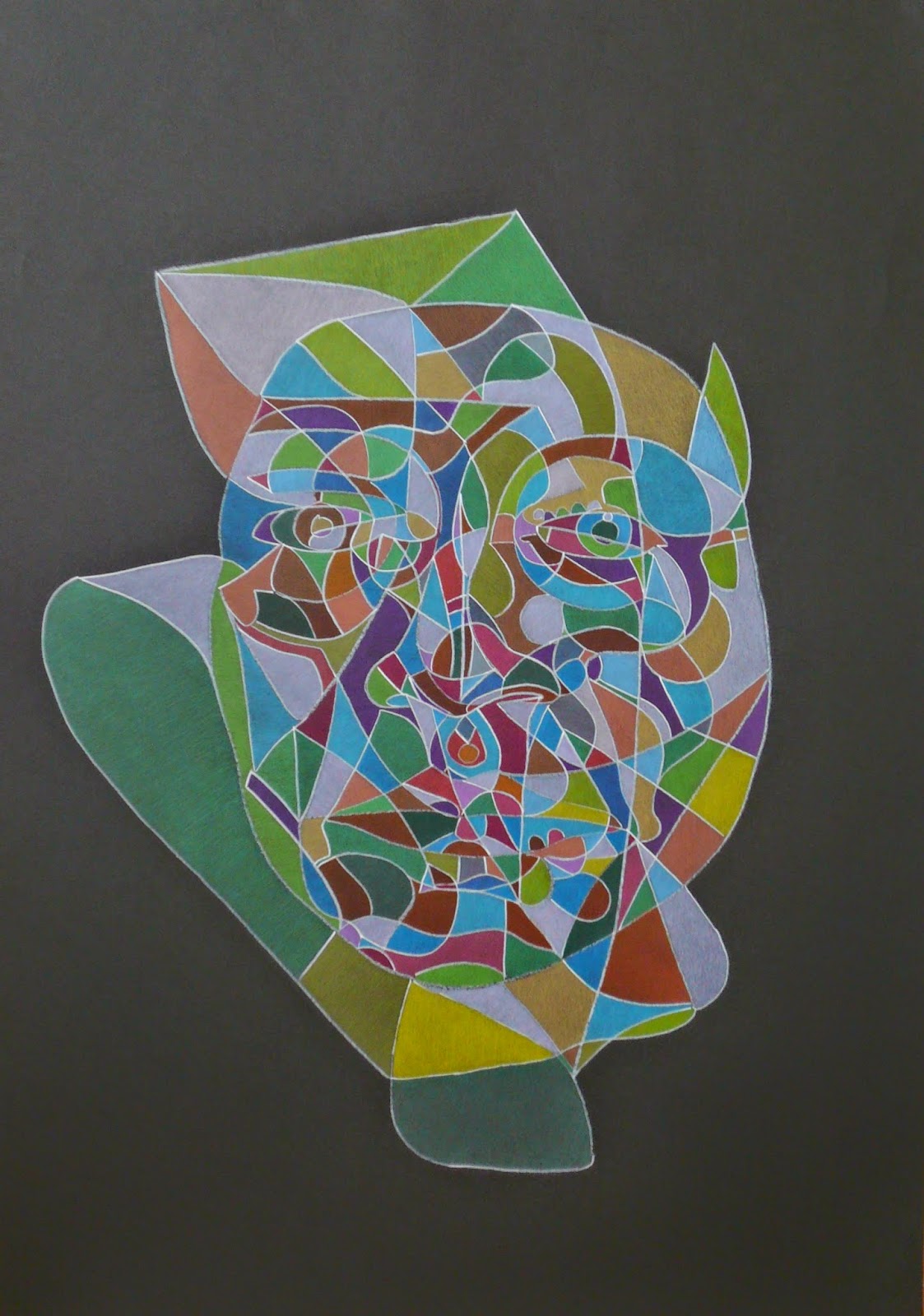
Monday, 27 April 2015
The Message of Art
Not
only is no man an island but, simply, there is no individual. This is
the message of art. Not
the “artist's message” which, like the putative individual,
doesn't exist or, if one insists on presenting
it as a discrete phenomenon, exists only on the level of total
opacity and incomprehensibility.
It
is precisely this chasm of subjectivity which art touches upon. To
confuse it with a personal or individual
profundity is, simultaneously, to mystify the human animal and to
deny unknowability to
human experience. It is to indulge in the magical thinking that
justifies material inequality by cultivating
the illusion of access to infinite self-hood and to escape from the
truth of the impossibility
of an unrelated self.
The
face is the basic node of human communication. It has been
through/with/by faces that the majority
of us have come to the identity we currently advertise and to the
personality we exhibit (taking
personality as that encrustation of possibility dried in the sun of
the contingent relationality that
has made up our social environment).
Before
the face is the other, the face is the self. One is what one sees and
even when one sees oneself,
one becomes two. So the greatest threat to the other, as an other,
is that it is assumed into the
self-hood of the subject which is the only agent capable of
recognising – and so manifesting – the
other.
Consciousness
is the breakdown in the order of material efficiency (physical
process). To say all art is
useless is on a par with conceptualising original sin: it insights
that necessity is infinite and impersonal,
a universal constant or ground that doesn't need any subject to
exist.
The
mothering of invention is not the field of human genius but its
matrix. The subject as such, whether inspired
or not, is the radical openness to this void of ownership – this
unrelenting and unconscious drive
to produce.
Here then, self is negative experience. It is what is not present: a lived absence that opens a gap in the illusion of the permanence of an ever changing world.
Here then, self is negative experience. It is what is not present: a lived absence that opens a gap in the illusion of the permanence of an ever changing world.
Subscribe to:
Posts (Atom)